
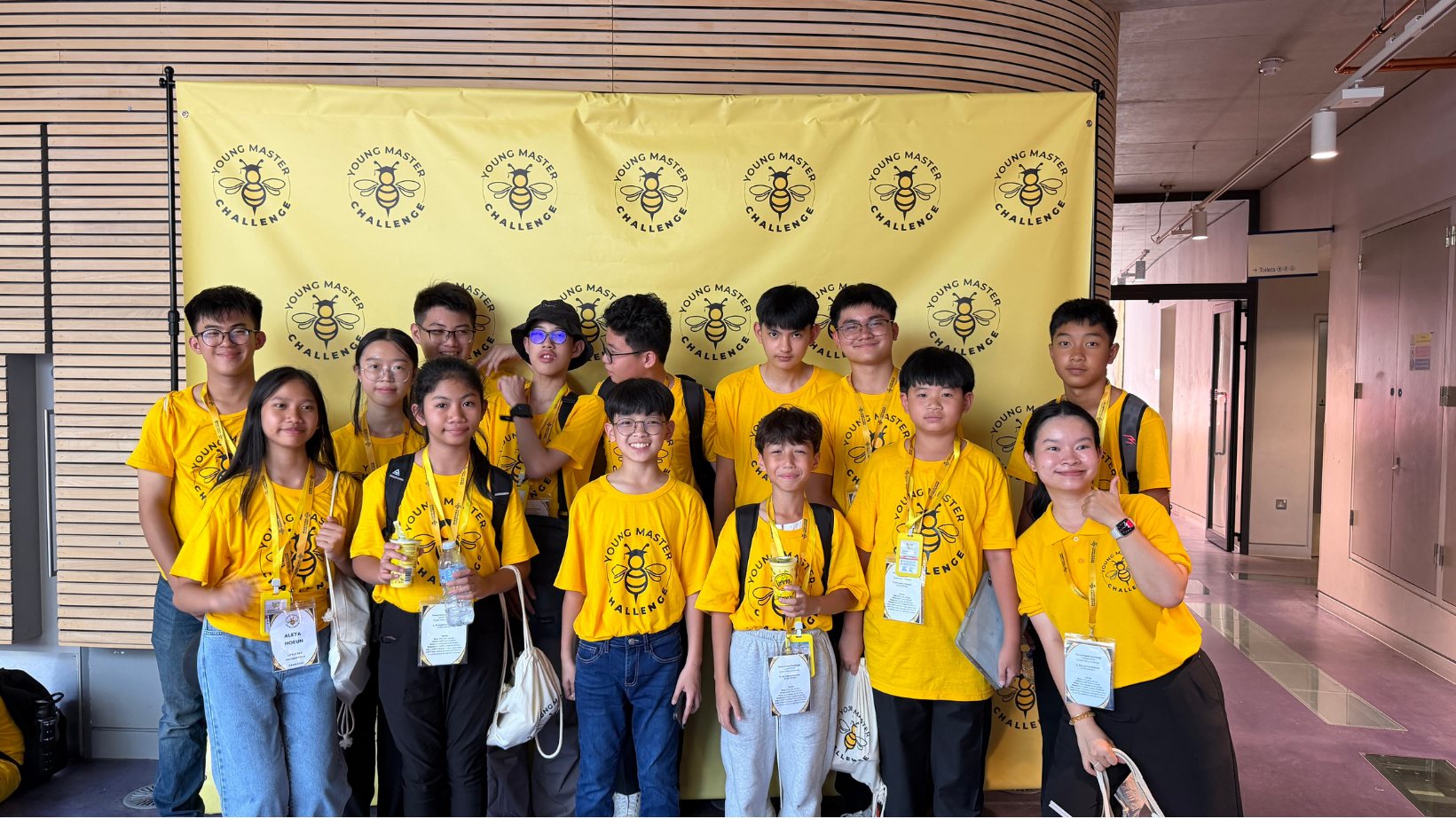
The Mathematics Competition offers a fun and challenging opportunity for participants to demonstrate their knowledge and skills in mathematics. It recognises and rewards the achievements of young mathematicians, encouraging conceptual understanding as well as the ability to recall and apply mathematical knowledge quickly and accurately.
Mathematics Competition
A fun and challenging experience for participants to showcase their knowledge and skills in Mathematics.
Mathematics Competition
Aims, Scope and Content
Through varied and progressively challenging problems, the competition helps participants strengthen their mastery of fundamental mathematical concepts and improve overall proficiency.
The competition places strong emphasis on using precise mathematical terminology to construct arguments, provide justifications and develop proofs while exploring patterns, relationships and generalisations.
Participants break down complex problems into manageable steps, persistently seek solutions and apply their mathematical skills to both routine and novel problems with growing sophistication.
Age Categories
Resources, tests and challenges are designed to be suitable for each age category.
| Category | Year of Birth | Level |
|---|---|---|
| Little Bee | 2017, 2016, 2015 | Ages 9-11 |
| Honeybee | 2014, 2013, 2012 | Ages 12-14 |
| Bumblebee | 2011, 2010, 2009 | Ages 15-17 |
2026-2027 Mathematics Themes
Mathematics for Sustainability
Little Bee
Ages 9-11
The Maths of Saving Our Planet
Use simple math to solve everyday environmental problems and make a positive impact.- Number
- Fractions
- Measurement
- Shape
- Time
- Money
- Tables and charts
- Simple logical reasoning
- Everyday sustainability calculations
Skills Developed
- Mental Calculation
- Problem Solving
- Data Interpretation
- Logical Thinking
Honeybee
Ages 12-14
The Maths of Smart and Sustainable Cities
Apply maths to design smarter communities and use resources efficiently.- Ratio
- Percentages
- Proportion
- Algebra
- Geometry
- Rates
- Data handling
- Probability
- Multi-step reasoning
- Resource-efficiency calculations

Skills Developed
- Analytical Thinking
- Logical Reasoning
- Data Analysis
- Mathematical Communication
Bumblebee
Ages 15-17
Mathematical Modelling for Global Decisions
Use advanced maths to analyse complex data and make responsible global decisions.- Advanced proportional reasoning
- Algebraic modelling
- Statistics
- Geometry
- Trigonometry
- Probability
- Exponential change
- Interpretation of complex data
- Sustainability modelling

Skills Developed
- Critical Thinking
- Advanced Problem Solving
- Data Interpretation
- Mathematical Modelling
Challenges
Online Knowledge Test
The Knowledge Test will consist of multiple-choice, single-entry and multiple-entry questions on a range of mathematical topics and resources shared with participants before the test. Participants will have 60 minutes to complete 30 questions, with three levels of difficulty contributing to a final score of 100.
Logical Bee
This challenge involves tasks that test the team's ability to understand and analyse information presented in non-verbal or numerical formats, such as diagrams, graphs, tables and mathematical operations.
Analytic Bee
This is a problem-solving challenge that tests each participant's ability to solve word problems, mathematical equations and real-world scenarios that require mathematical reasoning and problem-solving skills.
Speedy Bee
This is a mental arithmetic challenge that tests the team's ability to perform mathematical calculations quickly and accurately without pen and paper. It includes BODMAS, operations, puzzles and knowledge checks.
Inquisitive Bee
This challenge encourages participants to talk about mathematical concepts, their existence, importance and applicability. Teams are expected to speak for 2-3 minutes, with judges scoring delivery, content, language and overall impact.
Mathematics for Sustainability
Mathematics helps us understand the world and make better decisions. Throughout this year's competition, students investigate how mathematical thinking contributes to creating a more sustainable future by exploring real-life topics.
- ⚡Energy
- ♻Waste
- 💧Water
- 🌱Food
- 🚌Transport
- 🏢Buildings
- 📊Climate Data
- 🌍Population
- 🛒Sustainable Consumption
Participants apply mathematical concepts including fractions, percentages, ratios and graphs. Through these investigations, they learn that mathematics is more than numbers: it is a practical tool for solving problems, making informed decisions and building a better future.